The short answer
A chimney liner protects the masonry and helps your appliance vent safely. In East Midtown, new liners are most often needed after an oil-to-gas boiler conversion, a new appliance, or an inspection that finds damaged flue tile. We inspect first, then recommend and install a liner sized for your fuel and appliance.
East Midtown has a wide mix of chimneys in a small area. Pre-war apartment buildings have tall masonry flues serving a central boiler. Townhouses and brownstones on the side streets have fireplaces original to the house. Newer buildings have had appliances swapped over the years. In each case, the chimney liner keeps hot exhaust and condensation away from the masonry. PrimeFlue Chimney Services installs liners for homes and buildings across East Midtown, about a mile from our Manhattan office. Every job starts with finding out what the flue actually needs.
When an East Midtown Chimney Needs a New Liner
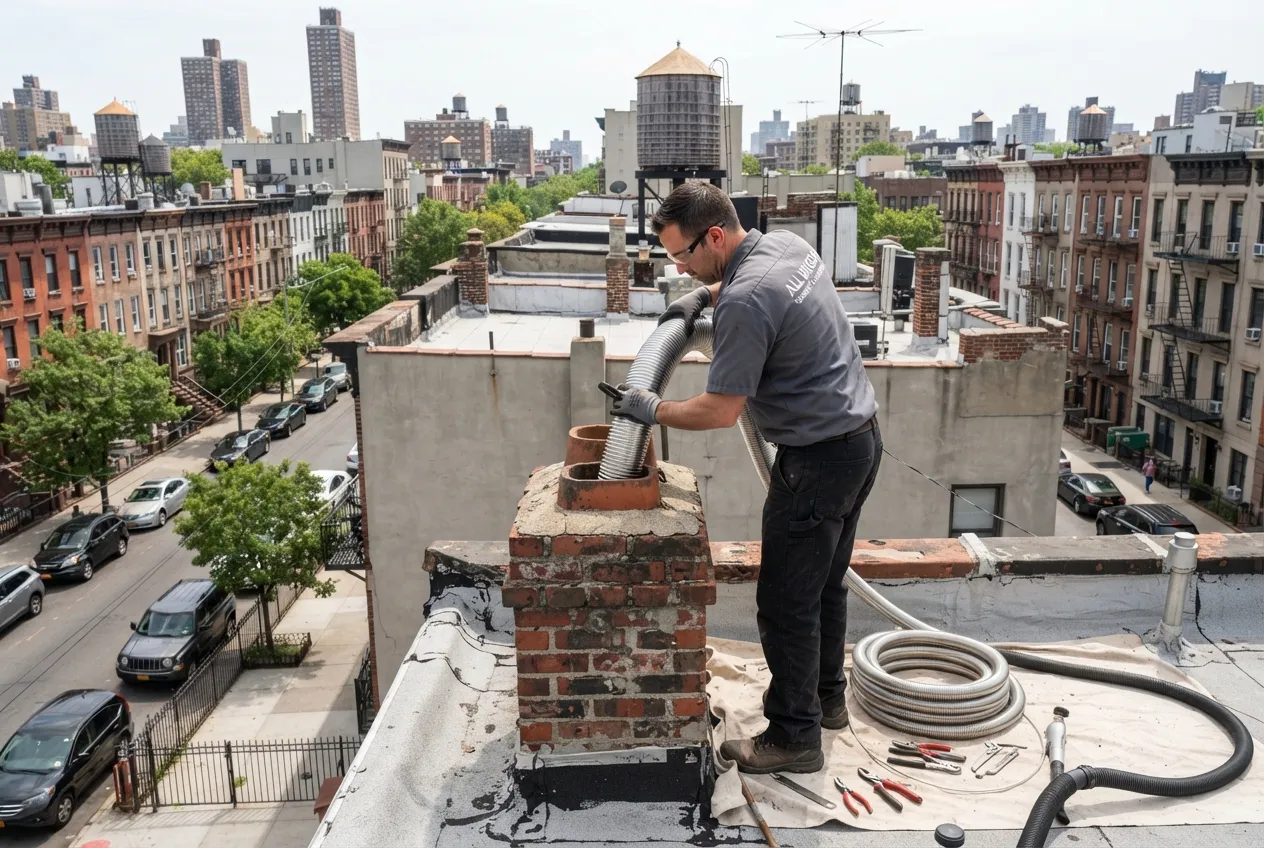
A liner is a channel inside the chimney sized to the appliance it serves. It is usually stainless steel, though some are clay tile or a cast-in-place material. The liner shields the surrounding brick and mortar from heat and corrosive byproducts, and it helps the appliance draft properly. Many older Manhattan chimneys were built with clay tile that has since cracked, shifted, or deteriorated. Some were never lined at all.
Stainless steel liners are the most common choice for gas and oil appliances and for wood stove inserts. They can be sized precisely and fed through flues with bends. Cast-in-place liners can make sense when the masonry itself needs reinforcement. The right option depends on the fuel, the appliance, and the condition of the chimney.
- Cracked, missing, or displaced flue tiles found during an inspection
- Converting a boiler or furnace from oil to gas
- Installing a new appliance, such as a wood stove insert or gas fireplace
- Flaking masonry, white staining, or moisture inside the chimney or on nearby walls
- A flue that is too large or too small for its appliance, causing poor draft
Oil-to-Gas Conversions and Liners
Many buildings in this part of Manhattan have moved, or are moving, from heating oil to natural gas. When a New York City building converts its boiler from oil to gas, the chimney has to be evaluated as part of the work, and a new liner is often needed. Gas exhaust produces acidic condensate. Over time, that moisture can corrode a masonry flue that handled oil without trouble.
Timing matters too. The city's heat season runs from October 1 through May 31, and during that period building owners must keep apartments heated to minimum temperatures. We coordinate with building management and the heating contractor so the chimney work fits the conversion schedule and the boiler is back online when it's needed. Scheduling liner work for late spring or summer usually gives everyone the most room.
How We Install a Chimney Liner
Every liner job starts with an inspection. Under the NFPA 211 standard, a Level 2 inspection applies when the system changes, such as a new appliance or a switch of fuel, and when a home is sold. That is often where we begin. Our certified technicians run a camera along the full length of the flue, check its dimensions, and note offsets, damage, and obstructions.
- Inspect and measure the flue, and confirm the appliance's venting requirements
- Recommend a liner type and size that matches the fuel and appliance
- Clean the flue and remove debris or broken tile as needed
- Install the liner, connections, insulation where called for, and a cap
- Check the draft, then walk you through what we did and what we found
Time for your annual chimney check?
Working in Manhattan Buildings and Townhouses
Liner work in East Midtown comes with practical details. Co-op and condo buildings may require roof access arrangements and elevator reservations, and the work has to be coordinated with a super or managing agent. We plan these details ahead of time, protect hallways and finished interiors, and keep the work area clean.
Townhouses and brownstones often have several flues sharing one chimney stack, with old fireplace flues and heating flues side by side. Before any work begins, we identify which flue serves which appliance.
A lined chimney still needs regular attention. NFPA 211 calls for chimneys, fireplaces, and vents to be inspected once a year. A Level 1 inspection is usually enough when nothing about the system has changed.
Serving East Midtown and Nearby Neighborhoods
We work with homeowners, co-op boards, and building managers throughout East Midtown, including ZIP codes 10017, 10022, 10152, 10154, 10167, 10169, 10170, 10171, 10172, and 10174. We also serve nearby Turtle Bay, Lenox Hill, Roosevelt Island, the Upper East Side, and Carnegie Hill.
More services in East Midtown
- Chimney Sweep in East Midtown
- Chimney Inspection in East Midtown
- Chimney Repair in East Midtown
- Air Duct Cleaning in East Midtown